 Design Duniya
Feature / FSSAI
One hexagon for sugar, one for salt, one for fat
Packaged food in India is heading for a new mark on the front of the box. On 26 November the Supreme Court told the food regulator how it should look: one hexagon per nutrient, each with a small picture, two words, and a size it can’t shrink below.
By DD Desk
26 Nov 2026 · 3 min read
A bench of Justices J.B. Pardiwala and K. Vinod Chandran issued the directions in a public interest case filed by 3S and Our Health Society. The case is about front-of-pack nutrition labelling, the warning that sits on the face of a pack rather than in the small nutrition table on the back.
One shape per problem
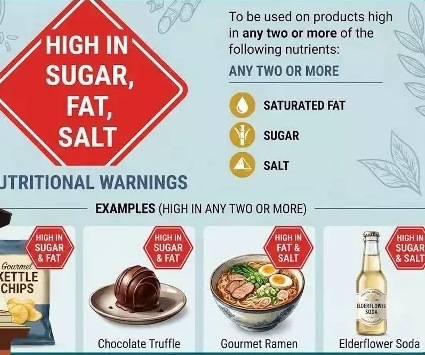
FSSAI’s earlier proposal used a single red hexagon that listed every nutrient a product was high in. The court has asked for separate hexagons instead: one for fat, one for sugar, one for salt. Each must carry a standard pictogram of that nutrient and the matching words HIGH FAT, HIGH SUGAR or HIGH SALT. A pack high in two things gets two marks, so the reader can count the problems at a glance.
A size it can’t shrink below
Labels tend to get squeezed when the rest of the pack is being designed. The order sets a floor: each hexagon should take up roughly 4–5% of the pack’s main display panel, in line with international practice. FSSAI must also fix a font size for the words inside, large enough to read under normal shopping conditions.
What counts as “high”
The court asked FSSAI to base the thresholds on total sugars and saturated fat, not added sugar and added fat, and to rework the limits from evidence. Set them too low and nearly every pack carries a warning, which the court said would cause label fatigue; set them too high and the warning stops meaning much.
Colour was already on the table. In September the same bench asked FSSAI to rethink its red hexagon, because Indian shoppers read red on a label as the non-vegetarian mark. The matter returns in ten weeks, when FSSAI must report progress on the draft rules.
What changed
The Supreme Court directed FSSAI to use a separate hexagonal warning for each of fat, sugar and salt on the front of packaged food, each with a pictogram and taking about 4–5% of the main panel.
Why it matters
- Separate marks let shoppers count problems instead of reading a list.
- A minimum size stops the warning being designed away.
- A pictogram works for shoppers who don’t read English.
Source
Reported by Social Samosa and LiveLaw (26 Nov 2026); September background from Verdictum. Images from Social Samosa and LiveLaw.